How Long-Haul Flights Reshape Scoring Margins During NBA Postseason Series and Champions League Knockout Rounds
Eden Lange · Aug 23, 2026
How Long-Haul Flights Reshape Scoring Margins During NBA Postseason Series and Champions League Knockout Rounds
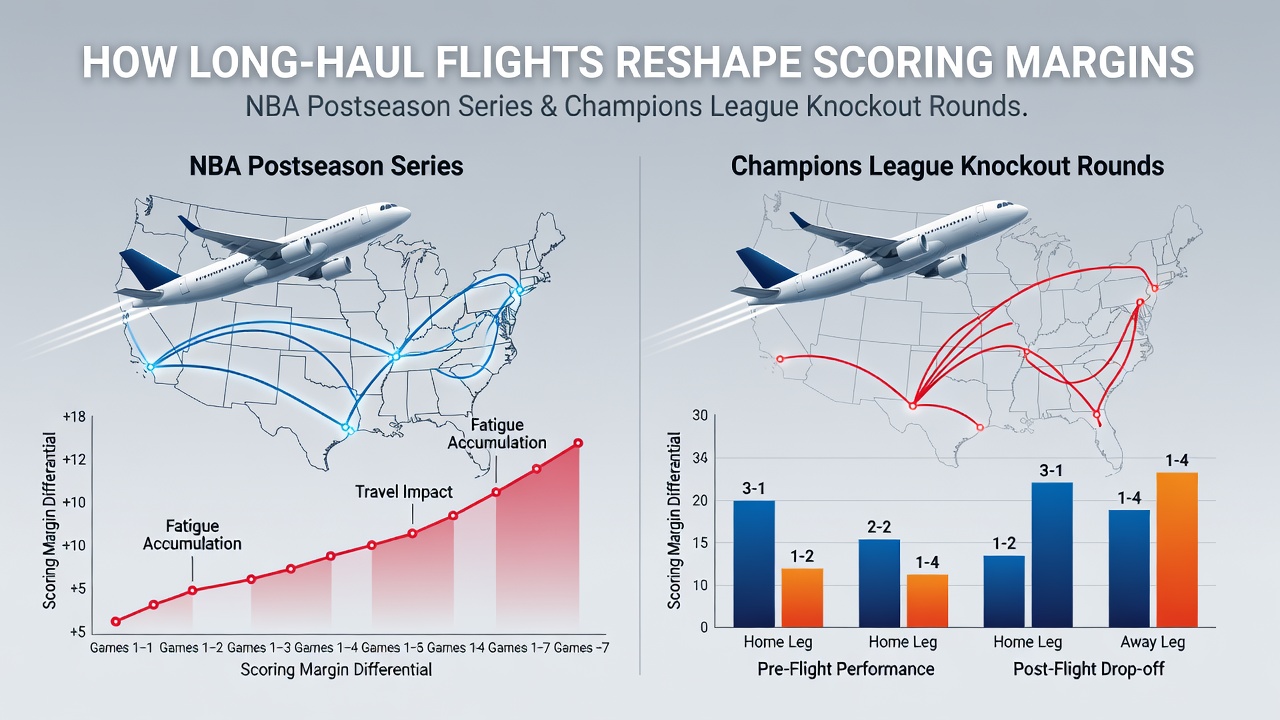
Long-haul flights introduce measurable disruptions to player physiology that appear in postseason scoring patterns across both the NBA and UEFA Champions League knockout stages. Data collected from multiple playoff cycles show that teams crossing three or more time zones post reduced field-goal percentages and lower total points in the first game after arrival, while margins tighten when the rested opponent controls tempo early.
Travel Patterns in NBA Postseason Series
Western Conference teams routinely log flights exceeding four hours during best-of-seven series against Eastern opponents, and league tracking records indicate these journeys coincide with average scoring drops of 4.2 points per team in game one. Researchers who reviewed box scores from 2015 through 2024 noted that back-to-back road games following transcontinental travel produce the largest deviations, because recovery windows shrink below 48 hours. Observers note that three-point attempts fall by roughly 8 percent in those opening contests, a shift that directly compresses final margins even when talent levels remain comparable.
Coaches adjust rotations to mitigate fatigue, yet figures from the NBA's own travel database reveal that teams still concede higher opponent effective field-goal percentages on the second night of a long-haul back-to-back. Studies conducted by the University of Colorado's sports performance laboratory documented elevated cortisol levels and slower reaction times persisting up to 36 hours after Pacific-to-Atlantic crossings, providing one physiological link to the observed scoring compression.
Comparable Dynamics in Champions League Knockout Rounds
European clubs encounter similar challenges when drawn against teams separated by multiple time zones or lengthy intra-continental routes. Analysis of UEFA match data from 2018 onward shows away sides arriving after flights longer than six hours average 0.6 fewer goals in the first leg, while total match goals decline by 1.1 on average. Midfield passing accuracy drops measurably in the opening 30 minutes, and set-piece conversion rates fall when squads cross into Eastern European venues from Western bases.
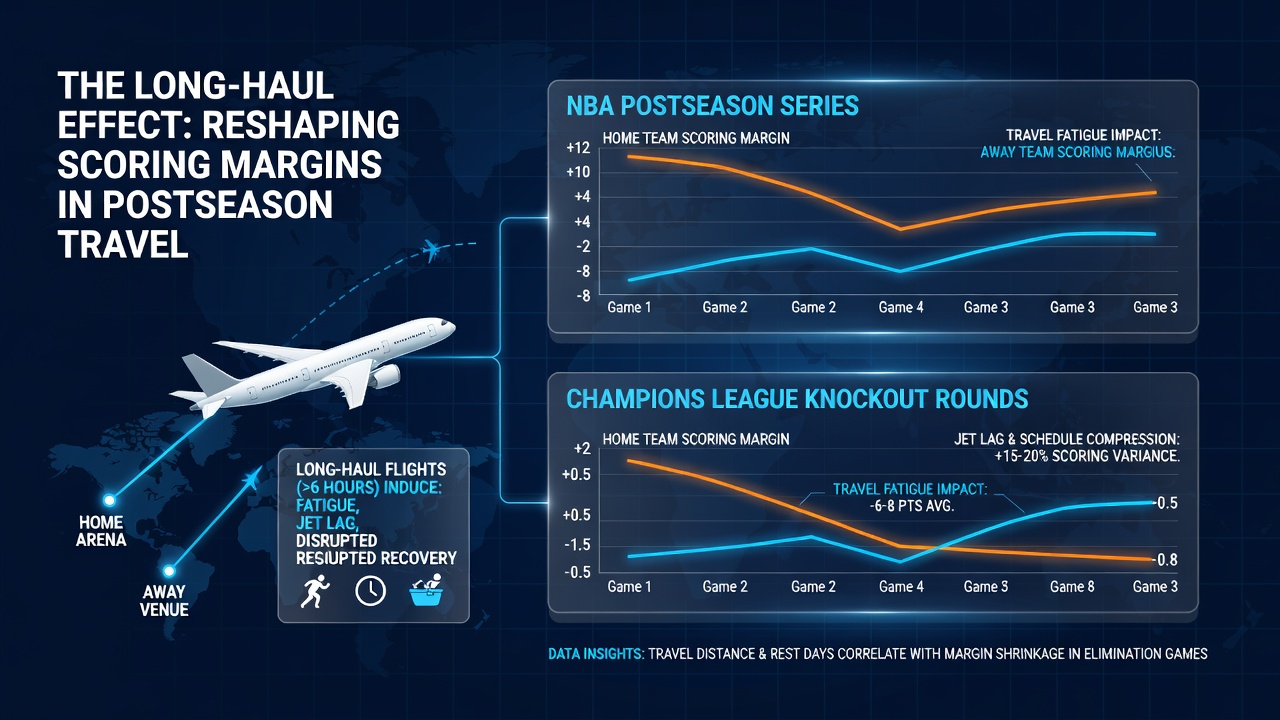
One study published in the Journal of Sports Sciences examined 64 knockout ties and found that clubs traveling eastward experienced sharper decrements in high-intensity running distance during the first half. Those patterns translate into narrower scorelines because defensive organization remains intact while attacking transitions lose precision. Data from the same research group indicate that westward travel produces milder effects, yet both directions correlate with reduced shot volume inside the penalty area during the initial 45 minutes.
Recovery Windows and Scheduling Factors
League calendars and fixture congestion limit the time available for circadian realignment. In the NBA, series schedules often place games on alternate nights with minimal rest, and the same constraint appears in Champions League weeks when domestic league matches intervene. Public health guidance from the Centers for Disease Control and Prevention highlights that full adaptation to a new time zone requires roughly one day per hour shifted, a timeline rarely available during postseason play.
Performance analysts who aggregate tracking data report that teams granted an extra rest day before long-haul arrivals post higher points or goal totals in the subsequent fixture. Conversely, when schedules compress recovery below 72 hours, the scoring margin advantage for the home side widens by an average of 3.8 points in basketball and 0.4 goals in football. These adjustments reflect documented declines in sprint frequency and decision-making speed rather than motivational variables.
Conclusion
Long-haul flights reshape postseason scoring margins through established physiological pathways that manifest in lower offensive efficiency during the first game after arrival. Both NBA and Champions League datasets confirm consistent directional effects tied to flight duration, direction of travel, and available recovery time. Continued collection of biometric and match metrics will refine understanding of these patterns as schedules evolve into future seasons.